Disclosure: Some links on this page are affiliate links. If you buy through them, I earn a small commission at no extra cost to you. I only recommend gear I actually believe in. Thanks for your support! — Jason
You’ve outgrown your basic audio interface and you’re ready to step up to a real podcast production console. The Zoom L8 and the RodeCaster Pro 2 are the two best options on the market right now. Both are excellent. Both are popular. And they’re built for slightly different kinds of creators. Here’s how to figure out which one is yours.
RodeCaster Pro 2 — $699
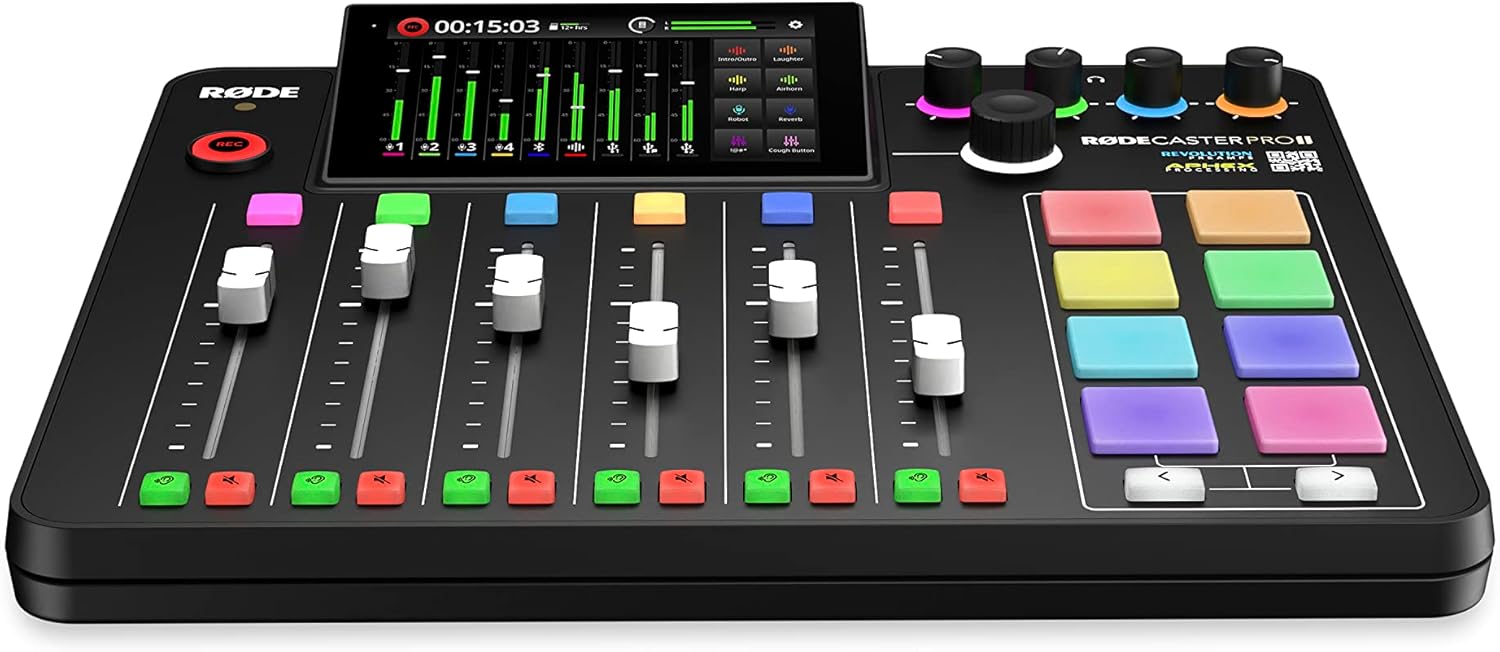
The RodeCaster Pro 2 is purpose-built for podcasting. Rode designed every single feature around the podcasting workflow, and it shows. Four XLR inputs with great preamps, individual channel processing (EQ, compression, noise gate per channel), SMART pads for triggering sound effects and music, Bluetooth for recording phone calls, and USB multitrack recording so every voice lands on its own track in your editing software.
The interface is touchscreen-driven and genuinely intuitive. You can set up a full professional-sounding show in an afternoon without reading a manual. The built-in processing is good enough that you can record guests who have never touched audio gear before and still come out with clean, usable recordings. That matters a lot when you’re managing a show with multiple guests and don’t have time to fix bad audio in post.
The SMART pads are addictive. Assign your intro music, a laugh track, a sound effect, an ad read jingle. Hit the pad and it plays instantly, perfectly mixed into your main output. For live-streamed podcasts especially, this is a game-changer. You go from sounding like a bedroom setup to sounding like a produced radio show.
View the RodeCaster Pro 2 on Amazon →
Zoom L8 LiveTrak — $399
The Zoom L8 gives you eight channels, multitrack recording, built-in effects, and more routing flexibility than the RodeCaster Pro 2. All for $300 less. That price gap is significant, and if you’re budget-conscious or if you use your gear for more than just podcasting, the L8 is a very compelling choice.
What the L8 does brilliantly is handle complexity. Eight channels means you can run four mics, a phone, music playback, and still have room to spare. Podcasters who also do live events, music sessions, or YouTube productions will get more mileage out of the L8 because it handles mixed-use scenarios better than the RodeCaster’s more podcast-focused design.
The tradeoff is the learning curve. The L8 is a traditional mixer at heart and it behaves like one. If you’re coming from zero mixer experience, it’s not as pick-up-and-go as the RodeCaster Pro 2. You’ll spend more time learning the routing, the effects chain, and the multitrack workflow before things click. It’s not complicated once you know it, but expect a steeper onboarding.
Microphone Pairings
Both units work well with any XLR dynamic mic. At this investment level, you should be running a mic that matches the quality of the console. My recommendations:
- Rode Procaster ($229) — a broadcast-grade dynamic that pairs perfectly with the RodeCaster ecosystem
- Shure SM7B ($399) — the gold standard broadcast mic, either unit drives it well
- Rode PodMic ($99) — still excellent at this level if you want to keep mic costs down per seat
Head-to-Head: Key Differences
Price: L8 is $399. RodeCaster Pro 2 is $699. That’s a real $300 difference.
Channels: L8 has 8. RodeCaster has 4 XLR plus additional inputs via USB and Bluetooth. For most podcasts, 4 XLR is plenty.
Ease of use: RodeCaster wins clearly. The touchscreen workflow is more intuitive for podcasting. The L8 requires more hands-on learning.
Processing: RodeCaster Pro 2 has per-channel EQ, compression, and noise gate built in. The L8 has effects too, but the RodeCaster’s podcast-specific processing is more refined for voice work.
Versatility: L8 wins if you do more than podcasting. It handles mixed-use scenarios better.
Which One Should You Get?
If podcasting is your primary focus and you want the best podcast-specific experience available, get the RodeCaster Pro 2. It is the better podcast tool. The workflow is smoother, the per-channel processing is better for voice, and the SMART pads are genuinely fun to use in production.
If you’re budget-conscious, do both podcasting and music/live sound, or want more channels for a larger panel show, get the Zoom L8. You’ll save $300 and get a more versatile unit.
Either way, you’re stepping into a seriously capable production setup. Your show will sound like a real production. BOOM.
Comments are closed